789BINGO games guide: how the bingo rooms really work
Bingo is the one casino product where your decisions are made entirely before the round begins. Once the first ball drops, nothing you do changes the outcome. That sounds boring; it is actually why bingo is the most budget-friendly thing in the 789BINGO lobby — and why understanding card quantity matters far more than any "strategy" you will see in a Facebook group.
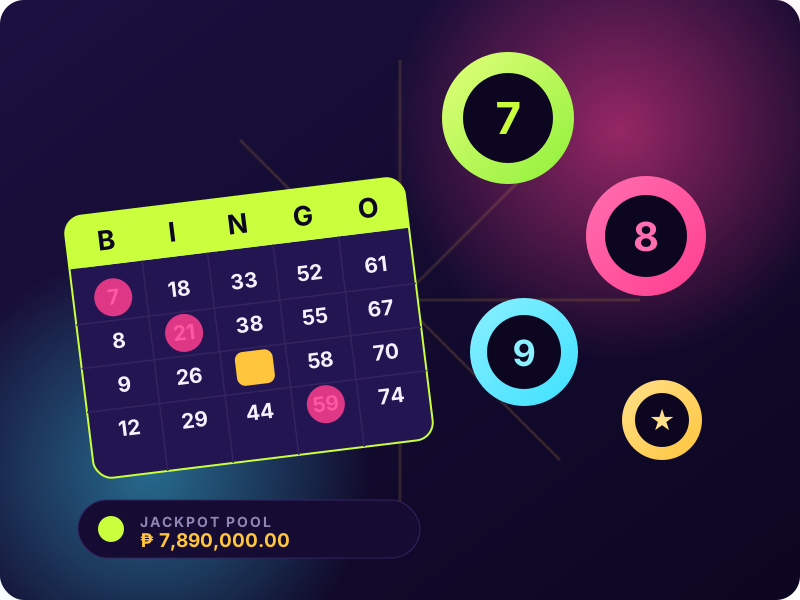
How an online bingo round works
Every round follows the same five beats: the room opens, players buy cards, buying closes, numbers are drawn by a random number generator, and the first card completing the required pattern wins. Online rooms auto-daub by default, so you cannot miss a call — the software claims for you.
The crucial difference from slots is that bingo is a pari-mutuel game. You are not playing against the house edge on each card; you are competing against the other players in the room for a prize pool funded by everyone's card purchases. More players means a bigger prize and a smaller chance of winning it. That trade-off is the entire game.
The general history and mechanics of the game, including how the 75- and 90-ball variants diverged, are well documented on Wikipedia's bingo entry if you want the background.
75-ball vs 90-ball: pick the right room
| 75-ball | 90-ball | |
|---|---|---|
| Card layout | 5×5 grid, free centre | 3 rows × 9 columns, 15 numbers |
| Numbers used | 1–75 under B-I-N-G-O | 1–90 |
| How you win | Complete a named pattern | One line, two lines, full house |
| Prizes per round | Usually one | Three separate prizes |
| Round length | 2–4 minutes | 3–6 minutes |
| Feels like | Pattern-hunting, more variety | Steady, three chances to place |
For a first session, 90-ball is the softer landing: three prize tiers per round means more frequent small wins, which stretches a ₱100 balance considerably further than a single winner-takes-all pattern. If you have not funded the account yet, the GCash cash-in guide covers the minimums.
Winning patterns you will actually see
75-ball rooms announce the pattern before buying closes. Read it — buying into a "blackout" round expecting a single line is a classic beginner error.
- Single line — any horizontal, vertical or diagonal row. Fastest, smallest prize.
- Four corners — the four outer squares only.
- Letter and shape patterns — X, T, kite, arrow. Mid-length rounds.
- Coverall / blackout — every square. Longest round, biggest prize, usually where the progressive jackpot sits.
- Progressive coverall — full card within a declining ball count. Rarely hit, which is exactly why the pot grows.
The free centre square counts. On a 5×5 card it is automatically daubed, which is why several patterns run through the middle. It slightly shortens every pattern that includes it.
The only bingo maths that matters
Here is the part that gets misrepresented constantly. In a fair bingo room, every card has an equal chance. There are no "hot" cards, no lucky number sets, no benefit to buying late or early.
Your probability of winning a round ≈ your cards ÷ total cards in the room.
If 40 players hold 10 cards each, the room has 400 cards. Buying 10 gives you roughly a 1-in-40 chance. Buying 20 doubles your chance to about 1-in-20 — and doubles your cost. Because the prize pool is funded by all purchases, buying more cards does not improve your expected return; it only reduces variance and makes wins more frequent and smaller.
Two practical conclusions follow:
- Quieter rooms are better value for your win rate, even though the prize is smaller. Fewer cards in play, same card price.
- Card quantity is a variance dial, not a profit lever. Set it to whatever keeps a session affordable for the number of rounds you want to play.
This is the opposite of how scatter slots behave, where the house edge is fixed per spin and volatility is baked into the game maths rather than the room population.
Worked example: ₱200, one evening
Cards at ₱4 each, 4 cards per round = ₱16 a round. That is roughly 12 rounds, or about 45 minutes of 90-ball play, before your balance is gone in the worst case. The same ₱200 at ₱10 a spin on a fast slot is 20 spins — about 90 seconds. Same money, wildly different entertainment per peso. This is the core argument in our beginner tips.
Prize pools, jackpots and guarantees
Three prize structures appear in Philippine bingo lobbies:
- Pari-mutuel pools — the prize is a share of card sales. Small room, small prize.
- Guaranteed prize rooms — a fixed peso prize regardless of attendance. These are genuinely good value when the room is quiet, and operators often cap purchases because of it.
- Progressive jackpots — a rolling pot won by hitting coverall within a set number of balls. Treat it as a lottery ticket attached to a game you were playing anyway, never as the reason to play.
Jackpot contributions are deducted from the pool, so a room with a large progressive pays smaller regular prizes. That is the trade, and it is disclosed in the room rules — read them the same way you should read bonus terms.
Seven practical room tips
- Check the pattern before buying. Coverall rounds cost more time and more cards.
- Prefer guaranteed-prize rooms during off-peak hours — late morning on weekdays is usually thinnest.
- Leave auto-daub on. Manual daubing on mobile is how winning cards get missed; see the app settings in the mobile guide.
- Budget per round, not per session. Cards × price × planned rounds should equal a number you decided in advance.
- Ignore chat "strategy". Card selection cannot beat a fair RNG.
- Watch bonus contribution. Bingo often contributes less than slots toward wagering — sometimes far less.
- Stop at your limit. Set it before you log in, using the tools on the responsible gaming page.
Bingo FAQ
Can I choose my own bingo card numbers?
Some rooms allow manual selection from available cards. It makes no difference to your odds — every card is equally likely.
What happens if two players win the same round?
The prize is split equally. With auto-daub, simultaneous claims are common on short patterns.
Do I have to watch the whole round?
No. Auto-daub claims for you. You can leave the tab and return — though on Android you should check the battery settings in the app guide.
Is bingo better value than slots?
Per hour of entertainment on a small budget, usually yes, because rounds are slow. In expected return terms, both carry a house margin — see the comparison on the games page.
Are the draws genuinely random?
At a licensed operator the RNG is independently tested. Verifying licensing is covered in the registration guide.